

To the OTH Regensburg website

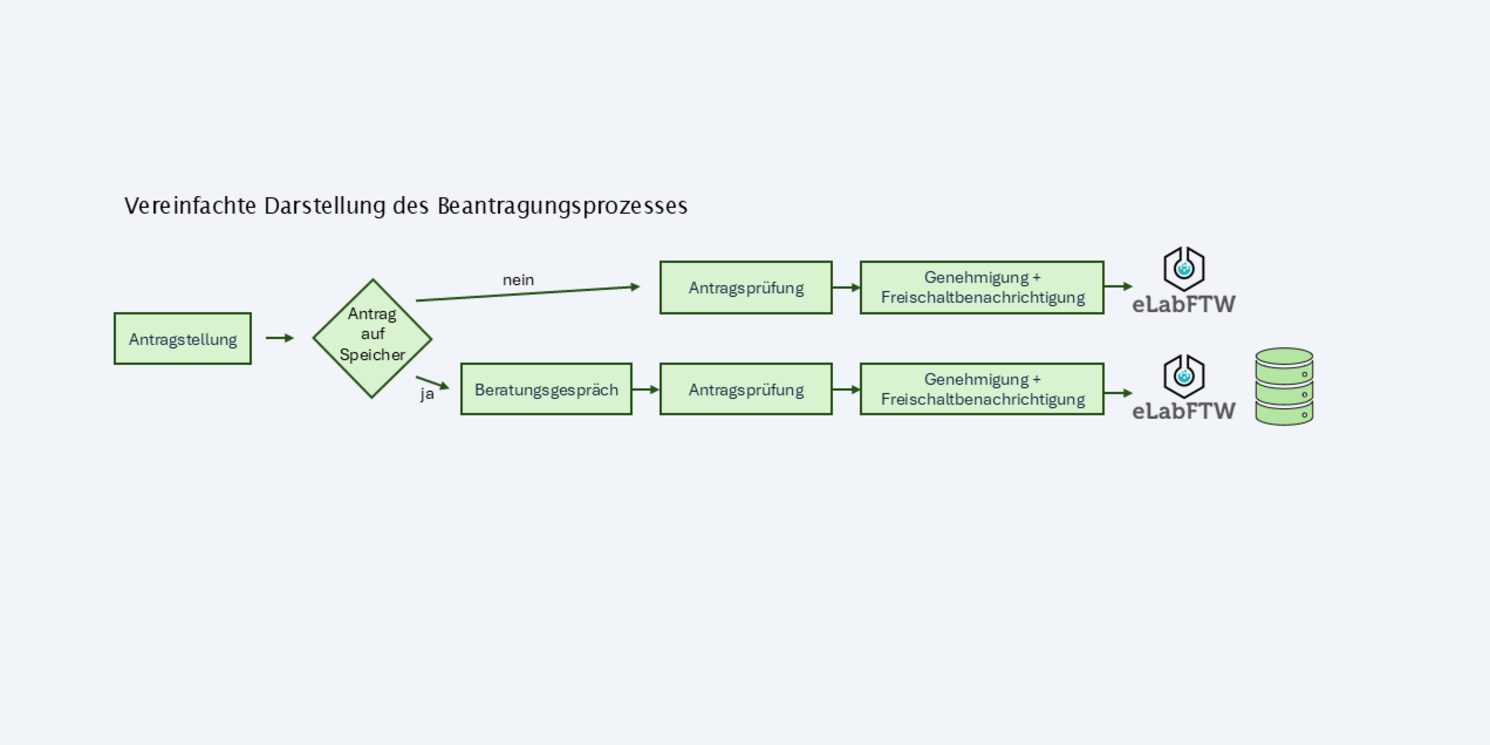
You can apply for the FDM package using the ‘Initial Application for the FDM Package’ form. Please note the preliminary information provided, particularly regarding storage space. Within the form, you can choose whether you are only interested in a team for eLabFTW (electronic laboratory notebook) or whether you would also like to apply for additional storage space.
We recognise the many benefits of managing a project alongside an electronic laboratory notebook, which is why we do not issue applications for storage space alone – without an eLabFTW team.

Further information on eLabFTW and storage space can be found below.
Preliminary information

  • electronic laboratory notebooks

    Laboratory notebooks are an indispensable part of many disciplines, as they play a crucial role in the planning, conduct and evaluation of scientific experiments. As research data is now predominantly held in digital form, electronic laboratory notebooks are becoming increasingly important and are gaining ever greater acceptance.

    Contrary to the assumption that electronic laboratory notebooks (ELNs) are relevant only to scientific disciplines, they offer a wide range of applications and are highly adaptable to other disciplines.

    Read more about the benefits an ELN can offer you here.


    What is eLabFTW?

    ELabFTW is an open-source electronic laboratory notebook for a range of disciplines. It is web-based software and can therefore be used on any platform. Just like physical laboratory notebooks, it supports the planning, execution and documentation of scientific experiments of all kinds. ELabFTW is designed to be flexible and open, and can therefore be used and adapted for a wide range of academic disciplines.


    Overview of key features:

    • digital planning, monitoring and documentation of experiments carried out in a team
    • Cross-experiment object database (for equipment, chemicals, etc.)
    • Calendar, templates, to-do lists
    • RFC 3161-compliant timestamps, versioning, tags
    • Export options in various formats (e.g. PDF, ZIP, CSV, JSON)
    • Available in several languages
    • API access for advanced users

    User Guide:


    eLabFTW at OTH Regensburg

    Since spring 2026, a university-specific instance has been available to all members of the university community. To set up a team for yourself and other members, the necessary information is requested in the application form. Once the account has been activated, you can then log in using your OTH ID.

    The service is free of charge and can be used without restriction. For any subsequent changes (e.g. changes to team members), please contact the FDM Advisory Service at fdm@oth-regensburg.de.

    Please note the terms of use for eLabFTW. Training sessions and introductory courses on eLabFTW are available; please do get in touch with us if you are interested.


  • What is the storage space used for?

    Depending on the project, a large volume of data may be generated – particularly during certain phases – for which existing storage structures, such as the university’s own P drive, are no longer sufficient. However, many laboratories and project groups do not have the capacity to operate their own servers and do not wish to resort to external services. The storage space provided as part of the FDM package offers the ideal solution here. For the purposes of the FDM package, the term ‘projects’ is not limited to officially recognised or funded projects. There are no minimum criteria defining what constitutes a project.

    In total, the university currently has 450 TB of storage space available. Anyone with a need for storage can register this and use it for a limited period. It is important to emphasise that this storage space is intended for the duration of the project and does not constitute either a publication platform or a long-term archive!

    Compared with the storage services provided by the IT Centre at OTH Regensburg, this research storage is subject to lower security and backup standards. No backups are created.
    Responsibility for the content, lawfulness and compliance of data processing always lies with the project management and the researchers.


    Terms of use

    Applications are made using the form, which asks for all the relevant information. Please note the information below under ‘Important information before submitting your first application’ before submitting your initial application for storage space.

    A project can be allocated up to 5 TB of storage space free of charge for one year. However, to ensure that as many people as possible have access to storage space, we ask that you provide a realistic estimate of the storage space required for your project. After one year, a follow-up application for storage space can be submitted, provided the project is still active. Free access for a project ends after a total of three years. From the fourth year onwards, an annual fee of currently €100 per TB applies.

    Costs will also apply if more than 5 TB is required. In this case, the charge is also €100 per TB per year for storage space exceeding the free allocation.

    Background to the costs: The costs incurred are not intended to generate a profit, but merely to cover the expenses involved. Our aim is to make the storage space available to as many projects as possible and to ensure it serves its intended purpose. Looking ahead, should demand be very high, the revenue generated could enable the purchase of additional storage.

    Why an annual deadline? – The annual deadline serves to ensure that the data stored there is not left unattended. Careful research data management requires regular data maintenance and an appropriate description of the data to be archived. These should ultimately be deposited in suitable locations (e.g. repositories) – where possible, in line with OTH Regensburg’s Open Access Policy, the publication of relevant research data is encouraged.


    Important information before submitting your first application

    The storage space is provided as part of OTH Regensburg’s research data management service. In order to integrate RDM more actively into practice and thereby comply with the guidelines on good scientific practice and OTH Regensburg’s RDM policy, a brief consultation with the RDM team at the University Library takes place as part of the initial application process. In order to provide you with efficient and sustainable support in relation to RDM that is tailored to your project, we require a Data Management Plan (DMP) when you first apply for storage space.

    A DMP serves to consider the necessary data management procedures early on in the project and to identify challenges. This allows for a targeted follow-up during the consultation with the FDM team at the University Library.

    There is no requirement to use a specific DMP template. If a DMP has already been drawn up as part of the project, this may be submitted. If one is not yet available, we recommend the following concise questionnaires on RDMO: RDMO Short Questionnaire OR the DFG Checklist.